Hi all -
I'm new here, so apologies in advance for any breach of etiquette or faux pas.
On my Pi-hole box I run dnscrypt-proxy on port 54 as my upstream provider (Cloudflare DoH), both for IPv6 and IPv4. I also run an additional custom proxy on port 55 to catch and sink Netflix IPv6 DNS lookups because Netflix blocks my IPv6 tunnel traffic. I catch the requests for the related domains to this proxy in a custom dnsmasq conf file.
As a result, according to the Pi-hole dashboard and query log, my queries are answered by localhost#54, a second localhost#54, and localhost#55.
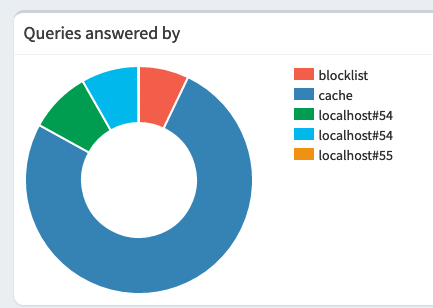
I would like to label these upstream providers so that it is easier to tell at a glance what service they correspond to, for example, "Upstream IPv4, "Upstream IPv6", and "Netflix DNS Proxy". Is there a way to achieve something like this using pi-hole or some other tool available in my environment?
Also, when I drill down from either localhost#54 on the dashboard "Queries Answered By" it seems to result in the same filtered query results. This seems like an undesirable behavior. I would either expect two different results (presumably one for IPv6 and one for IPv4) or a single aggregation on the dashboard. Perhaps this is a defect?
If any of these details help, I am running Pi-hole 5.3.1 (web v5.5, FTL v5.8.1) using nginx 1.14.2 + php 7.4, on the Homebridge Raspberry Pi image v1.0.23 (based on Raspbian Buster Lite (2021-05-07) on a Raspberry Pi 4B.
Thanks in advance for any help,
Demetrios