Hello,
A few days ago I finally connected the SolarEdge inverter to my FritzBox guest network (which I use to segregate any of the "smart" devices from my valuable devices), and a couple of hours later the Pi-hole logged a query pair (repeated quite a few times) which shows as
Jul xx hh:mm:ss dnsmasq[684]: query[A] 7e07ce34 from [FritzBox IP]
Jul xx hh:mm:ss dnsmasq[684]: query[AAAA] 7e07ce34 from [FritzBox IP]
The same query pair has occurred in semi-regular intervals (roughly twice a day) since then.
Since the SolarEdge is in the guest network, Pi-hole can't see whether the query does indeed originate in the SolarEdge inverter, in the router itself or any of the guest clients.
Before I go down the route of chasing whatever device sends this and why - has anyone seen similar things? If yes, what is it?
My plan to chase the query is to
Put a cascaded FritzBox behind the main one
Build a subnet from the second one for all the smart stuff
Another user recently reported invalid queries from their solar inverter (different branding to yours).
The query isn't for a valid domain, so even if it goes upstream from Pi-hole, it isn't really going anywhere. Unless it starts hammering your network non-stop it is probably not actually a problem.
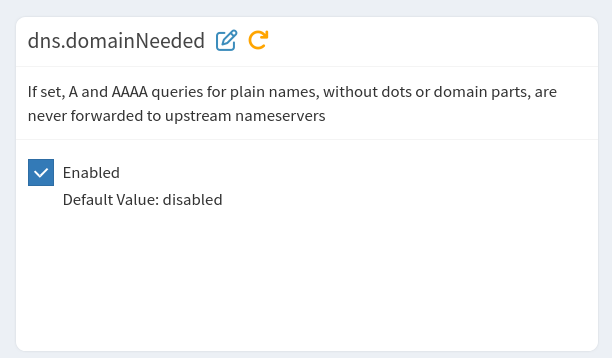
If you want to make sure the malformed domain requests don't leave your network, you could enable dns.domainNeeded (in settings -> expert -> dns server)
So far, I've seen just one at a time, also it's not only at start-up (of the device, of course not sure about processes).
I think that each time I see one of those, there's a proper request to something I would expect the converter to connect to within two or three minutes -ish. Will have to check proper, though.
IoT gear generally doesn't have a browser inside, and chrome's requests all contain valid alphanumeric characters which are permitted in domain names. Unlikely to be chrome in this instance.
Thanks, I probably wouldn't have expected it to be Chrome anyway. The idea to use non-domains for detecting stuff might not be unique to Chrome, maybe.
I thought all alphanumeric characters were okay to use in domain names, what do you see that isn't allowed?
Taken as hex, depending on encoding it would resolve to 4, I think, or to weird stuff.
In any case, Pi-hole seems to think it's alphanumeric.
Also, after weaving a second Pi-hole into the IoT subnet to properly pinpoint query origins, I can confirm it's from the inverter. It also tried a few (partially weird...) domain endings the second time round, although I'm not sure whether some of those get distributed with the DHCP lease:
7e07ce34.fritz.box
7e07ce34.#
7e07ce34.eth0
It's only ever misbehaving with the same string. For the time being, I've regex blocked anything with these strings in Pi-hole, just to feel better.
I've started asking the installing company, may reach out to manufacturer soon if they don't.
Well... at least I would expect that if someone hacked the inverter they wouldn't advertise it by sending rogue, malformed DNS queries around the network - so I kind of hope it's nothing too dangerous... fingers crossed.